

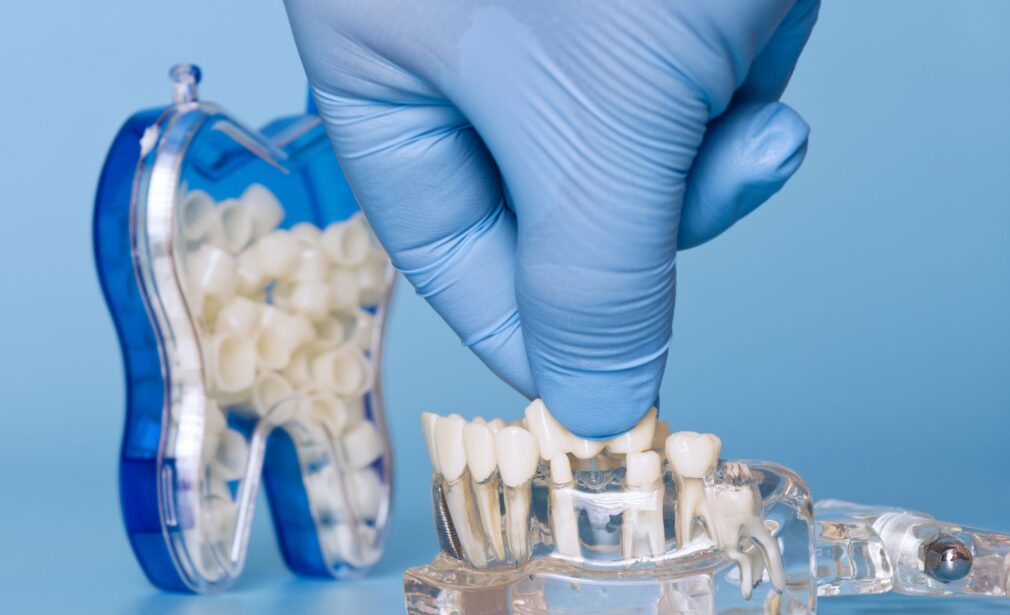
Restore Damaged and Missing Teeth with Natural-Looking Fixed Restorations
Damaged, broken or missing teeth can affect your ability to chew, speak and smile confidently. Dental crowns and bridges in Chandigarh can restore the shape, strength, function and appearance of your teeth.
Hollywood Smile provides customized dental caps and fixed dental bridges based on your oral health, bite, remaining tooth structure and aesthetic requirements. Every restoration is carefully planned to provide a comfortable fit and natural-looking result.
BOOK A DENTAL CROWN OR BRIDGE CONSULTATION
Call: +91 82888 38222
What Is a Dental Crown?
A dental crown, commonly called a tooth cap, is a custom-made restoration that covers the visible part of a damaged or weakened tooth. It helps restore the tooth’s shape, size, strength and appearance.
A crown may be recommended when a tooth has lost a significant amount of its natural structure and cannot be predictably restored with a regular filling.
The American Dental Association explains that crowns can strengthen teeth with large fillings, protect weak teeth, restore broken teeth, support bridges and cover dental implants.
When Is a Dental Crown Required?
After Root Canal Treatment
A root canal-treated tooth may require a dental crown when it has lost significant structure or needs protection from chewing forces. Crowns are frequently recommended for back teeth following RCT.
Severely Decayed Tooth
When a cavity is too large for a conventional filling, a crown may cover and protect the remaining healthy tooth structure.
Broken or Cracked Tooth
A crown can hold together and protect certain teeth affected by cracks, fractures or extensive wear. Not every cracked tooth can be saved, so a clinical examination is necessary.
Large or Damaged Filling
A tooth with a very large filling may become weak over time. A crown may be recommended when there is insufficient natural structure to support another filling.
Worn-Down Teeth
Teeth damaged by grinding, clenching, acid erosion or an uneven bite may sometimes be restored with dental crowns as part of a comprehensive treatment plan.
Discoloured or Misshapen Tooth
An aesthetic dental crown may improve a severely discoloured or irregularly shaped tooth when more conservative options are unsuitable.
Dental Implant Restoration
A custom dental crown can be attached to a dental implant to replace the visible portion of a missing tooth.
What Is a Dental Bridge?
A dental bridge is a fixed restoration used to replace one or more missing teeth. It fills the gap with artificial replacement teeth supported by natural teeth, dental implants or a combination determined by the treatment plan.
Unlike a removable denture, a fixed dental bridge cannot be taken out by the patient. The American Dental Association describes a bridge as a restoration that replaces missing teeth and bridges the space where teeth are absent.
When Is a Dental Bridge Required?
A fixed dental bridge may be considered when:
- One or more teeth are missing
- Adjacent teeth are suitable for support
- A patient wants a fixed replacement option
- Chewing is affected by a missing tooth
- Teeth are shifting towards an empty space
- A visible gap affects the smile
- A dental implant is unsuitable or not preferred
The condition of the supporting teeth, gums and bone must be evaluated before recommending a bridge.
Types of Dental Crowns
Zirconia Crowns
Zirconia is a tooth-coloured ceramic material commonly used for dental crowns. It offers strength and may be suitable for front or back teeth, depending on the clinical situation and restoration design.
All-Ceramic Crowns
All-ceramic crowns contain no metal and can provide a natural-looking appearance. They may be considered for visible front teeth where colour and translucency are important.
Target keyword: Ceramic dental crowns Chandigarh
Porcelain-Fused-to-Metal Crowns
A porcelain-fused-to-metal or PFM crown has a metal base covered with tooth-coloured porcelain. It combines structural support with an aesthetic outer layer.
Over time, a dark line may sometimes become visible near the gumline, particularly if the gums recede.
Metal Crowns
Metal crowns are known for strength and may require less removal of tooth structure in some situations. Their metallic appearance makes them more suitable for less visible areas when clinically appropriate.
Implant-Supported Crowns
An implant crown replaces the visible part of a missing tooth and is attached to a dental implant. The crown is customized for size, shape, colour, bite and fit.
Types of Dental Bridges
Traditional Dental Bridge
A traditional or conventional bridge uses crowns on teeth next to the gap to support one or more artificial teeth.
The supporting teeth require preparation before the bridge can be fitted. Their health and strength must be carefully evaluated.
Cantilever Dental Bridge
A cantilever bridge is supported by a tooth on only one side of the missing space. It is used selectively because chewing forces can place additional stress on the supporting tooth.
Maryland Dental Bridge
A Maryland or resin-bonded bridge uses wings that attach to the back surfaces of neighbouring teeth. It may require less tooth preparation than a traditional bridge but is not appropriate for every tooth position or bite.
Implant-Supported Bridge
An implant-supported bridge uses dental implants instead of natural teeth for support. It can replace multiple missing teeth without relying entirely on neighbouring natural teeth.
Benefits of Dental Crowns
Strengthens a Weakened Tooth
A crown covers and supports a tooth weakened by decay, a fracture or a large filling.
Protects a Root Canal-Treated Tooth
A suitable crown can help protect a root canal-treated tooth from further structural damage.
Restores Chewing Function
A correctly fitted crown restores the tooth’s shape and allows chewing forces to be distributed more effectively.
Improves Tooth Appearance
A tooth-coloured crown can improve the shape, size and visible colour of a damaged tooth.
Covers a Dental Implant
A customized crown completes a single-tooth dental implant restoration.
Benefits of Dental Bridges
Replaces Missing Teeth
A bridge fills a visible or functional gap created by one or more missing teeth.
Restores Chewing Ability
Replacing missing teeth may make eating more comfortable and help distribute chewing forces.
Improves Speech
Missing teeth can affect pronunciation. A properly designed bridge may help restore clearer speech.
Maintains Smile Appearance
A tooth-coloured bridge can restore continuity and balance to the smile.
Helps Limit Tooth Movement
Replacing a missing tooth can help reduce the tendency of neighbouring teeth to move into the empty space.
Dental Crown Procedure at Hollywood Smile
1. Consultation and Examination
The dentist examines the affected tooth, gums and bite. Dental X-rays may be recommended to evaluate the roots, surrounding bone and remaining tooth structure.
2. Treating Existing Problems
Decay, infection or gum inflammation may need treatment before the crown procedure. Root canal treatment is only recommended when clinically necessary.
3. Preparing the Tooth
The tooth is carefully shaped to create sufficient space for the dental crown. Local anaesthesia may be used to make the procedure comfortable.
4. Impression or Digital Scan
An impression or scan records the prepared tooth, neighbouring teeth and bite. The information is used to manufacture a customized crown.
Dental laboratories make crowns and bridges using the dentist’s prescription and an impression or digital scan of the patient’s teeth.
5. Temporary Crown
A temporary crown may be fitted to protect the prepared tooth while the final restoration is being made.
6. Final Crown Placement
The permanent crown is evaluated for fit, contact, bite and appearance. After necessary adjustments, it is fixed onto the prepared tooth.
Dental Bridge Procedure at Hollywood Smile
1. Assessment of the Missing-Tooth Area
The dentist examines the gap, supporting teeth, gums and bite. X-rays may be taken to assess the roots and bone.
2. Selecting the Bridge Design
The appropriate bridge type is selected according to the number of missing teeth, strength of neighbouring teeth, location of the gap and available treatment options.
3. Preparing the Supporting Teeth
For a conventional bridge, the teeth next to the gap are shaped to receive crowns. The amount of preparation depends on the planned restoration.
4. Recording the Teeth and Bite
An impression or digital scan is taken to help create the customized dental bridge.
5. Temporary Restoration
A temporary bridge may protect the prepared teeth and maintain appearance while the final bridge is manufactured.
6. Fitting the Final Bridge
The final restoration is checked for comfort, appearance, contact and bite before being permanently fixed.
Dental Crown After Root Canal Treatment
Patients often ask whether a dental crown is compulsory after RCT. The answer depends on the tooth’s location, remaining structure and risk of fracture.
Back teeth experience stronger chewing forces and frequently require a crown after root canal treatment. A front tooth with sufficient healthy structure may sometimes be restored differently.
Crowns are commonly used to restore teeth weakened by decay, large fillings, wear, fractures or root canal treatment.
Your dentist will recommend a restoration after assessing the individual tooth.
Dental Crown vs Dental Veneer
A dental crown covers most or all of the visible portion of a tooth. It is generally used when a tooth requires greater structural protection.
A dental veneer is a thin covering placed primarily over the front surface of a tooth to improve its appearance. Veneers may be suitable for selected cosmetic concerns but do not provide the same coverage as a crown.
The most conservative clinically suitable option should be selected after examining the tooth.
Dental Bridge vs Dental Implant
Both bridges and implants can replace missing teeth, but they work differently.
Dental Bridge
A conventional bridge receives support from neighbouring teeth. These supporting teeth usually require preparation.
Dental Implant
An implant is placed in the jawbone and supports a crown without relying on adjacent teeth. Implant treatment involves surgery and sufficient healing time.
The appropriate choice depends on:
- Health of neighbouring teeth
- Amount of available bone
- Gum condition
- Location of the missing tooth
- Medical history
- Treatment time
- Oral-hygiene ability
- Budget and preferences
Hollywood Smile provides a personalized comparison after examining the missing-tooth area.
How Long Do Crowns and Bridges Last?
Dental crowns and bridges are designed as long-term restorations, but they do not last forever. Their lifespan depends on:
- Quality of the supporting teeth
- Oral hygiene
- Gum health
- Bite forces
- Teeth grinding or clenching
- Diet and chewing habits
- Material selected
- Regular professional examinations
- Decay around the restoration margins
A restoration may require repair or replacement if it becomes loose, fractured, worn or affected by decay.
Caring for Dental Crowns and Bridges
Brush Twice Daily
Clean crowns and bridges using fluoride toothpaste and a soft-bristled toothbrush.
Clean Around the Gumline
Plaque can accumulate where the restoration meets the gum. Clean this area carefully every day.
Clean Under the Bridge
A bridge requires special cleaning beneath the artificial tooth. Your dentist may recommend floss threaders, interdental brushes or a water flosser.
Avoid Biting Hard Objects
Do not chew ice, open packaging with your teeth or bite other hard objects that could damage the restoration.
Wear a Night Guard When Recommended
Patients who grind or clench their teeth may require a protective night guard.
Attend Regular Check-Ups
Routine examinations allow the dentist to check the fit, bite, supporting teeth and surrounding gums.
What Should You Do if a Crown or Bridge Comes Loose?
Do not attempt to permanently glue a loose crown or bridge at home. Household adhesives may damage the tooth, restoration and gums.
Keep the restoration safe and contact your dentist. Avoid chewing on the affected side until the tooth has been examined.
Seek prompt care if you also experience severe pain, swelling, trauma or difficulty closing your bite.
Dental Crowns and Bridges Cost in Chandigarh
The cost of dental crowns and bridges in Chandigarh depends on the condition of the teeth, selected material and complexity of treatment.
Factors affecting the price may include:
- Type of crown or bridge
- Zirconia, ceramic, PFM or metal material
- Number of teeth being restored
- Number of missing teeth
- Condition of supporting teeth
- Need for root canal treatment
- Core buildup or post requirement
- Implant-supported restoration
- Dental-laboratory work
- Temporary restoration
- Complexity of the bite
An accurate quotation can only be provided after a dental examination. Ask whether the estimate includes tooth preparation, temporary restoration, laboratory work and final fitting.
Why Choose Hollywood Smile for Crowns and Bridges?
Personalized Treatment Planning
Each crown and bridge is planned according to the condition of your teeth, gums, bite and smile.
Natural-Looking Restorations
Tooth-coloured restorations are customized for shape, size and shade to complement the surrounding teeth.
Complete Restorative Dental Care
Examination, root canal treatment, tooth preparation, temporary restorations and final crowns or bridges can be coordinated under one roof.
Focus on Tooth Preservation
We evaluate whether a tooth can be conservatively restored before recommending extensive treatment.
Clear Explanation of Options
Available materials, treatment steps, limitations, maintenance and costs are explained before treatment begins.
Convenient Chandigarh Location
Hollywood Smile is located in Sector 9C for patients seeking dental crowns, tooth caps and fixed dental bridges in Chandigarh.
Frequently Asked Questions About Dental Crowns and Bridges
Is a dental crown the same as a tooth cap?
Yes. A tooth cap is the common term used for a dental crown. It covers and protects the visible portion of a prepared tooth.
Do I need a crown after root canal treatment?
It depends on the tooth and remaining structure. Back teeth commonly require crowns because they experience heavy chewing forces.
Which dental crown is best?
The most appropriate material depends on the tooth’s position, remaining structure, bite, aesthetic needs and budget. No single crown type is best for every patient.
Are zirconia crowns suitable for front teeth?
Zirconia crowns may be used for front or back teeth depending on the selected material, design and clinical requirements. Your dentist will recommend a suitable aesthetic option.
Can a bridge replace more than one tooth?
Yes. A dental bridge may replace one or more missing teeth, provided suitable support is available.
Is a dental bridge removable?
A fixed dental bridge cannot be removed by the patient. Only a dentist can remove or replace it.
Does getting a crown hurt?
The tooth is generally prepared under local anaesthesia. Temporary sensitivity or gum tenderness may occur after treatment.
Can decay develop under a crown?
Yes. Natural tooth structure remains beneath the crown and can develop decay, especially around the margins. Good oral hygiene and check-ups remain essential.
How do I clean under a dental bridge?
Use a floss threader, interdental brush or another cleaning aid recommended by your dentist to remove plaque beneath the replacement tooth.
How much do crowns and bridges cost in Chandigarh?
The cost depends on the material, number of teeth, supporting-tooth condition and any additional treatment required. An examination is necessary for an accurate estimate.
Book a Dental Crown or Bridge Consultation in Chandigarh
Restore damaged teeth and replace missing teeth with a personalized fixed restoration at Hollywood Smile.
Visit:
Hollywood Smile
SCO 139–140, First Floor
Sector 9C, Chandigarh
Call: +91 82888 38222